Our Cellulose Acetate Compostable Straw
Biodegradable and Compostable
We are aware of your concern for the environment
That is why at POPOMEX and BIOMARINE, in regards to the issues of environmental care, we have taken on the task of researching and developing the best options of materials and technologies, both biodegradable and compostable, that are friendly to the environment and care for our planet. Similarly, this research and development has been done with the purpose of taking care of the economic issue for all our customers.
POPOMEX and BIOMARINE has also reviewed that all the materials we use are perfectly approved by the ASTM and UNE regulations and have the corresponding certifications. In this way, we guarantee the biodegradation of the products our customers buy, since nowadays many products that claim to be “Biodegradable or Compostable” are sold without really being so.
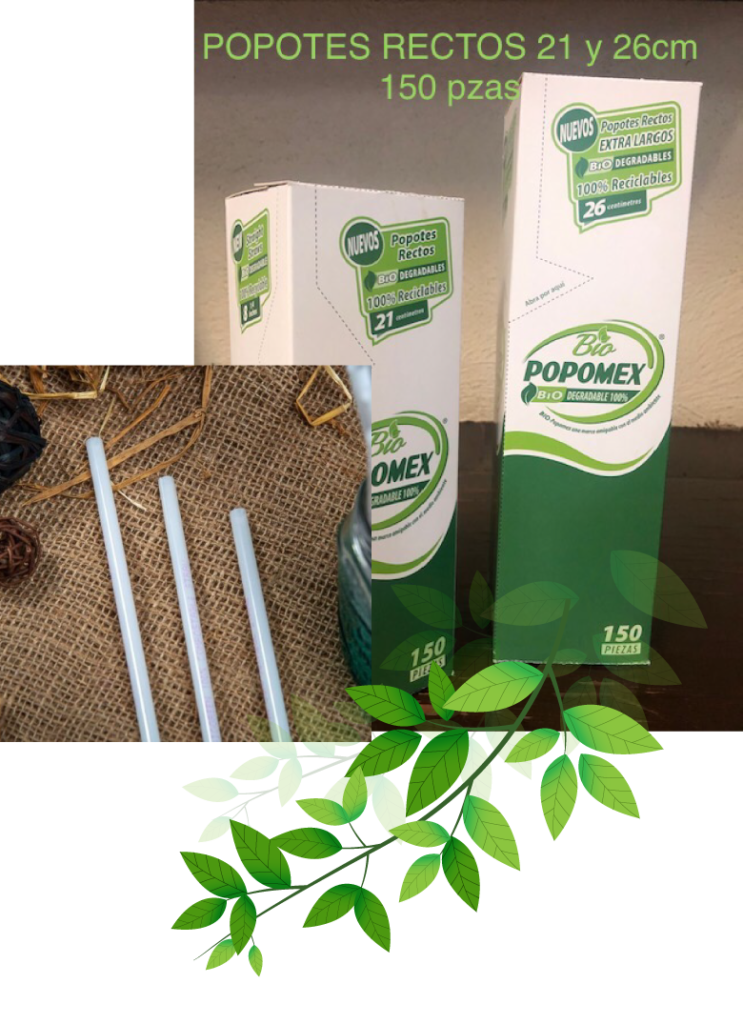
POPOMEX and BIOMARINE is in position to offer the following options of biodegradable straws depending on the needs and requirements of our customers:

A smarter straw
Using a disposable straw doesn’t have to be a guilty pleasure. Straws made with Eastman Aventa™ compostable materials perform as well as traditional plastic straws while eliminating excess waste.
They do that because of their compostable nature. Straws made with Aventa break down in soil and will not remain as microplastics unlike when traditional plastics biodegrade. Items made with Aventa Renew feature another level of sustainability — they’re made from certified recycled content using ISCC mass balance allocation.
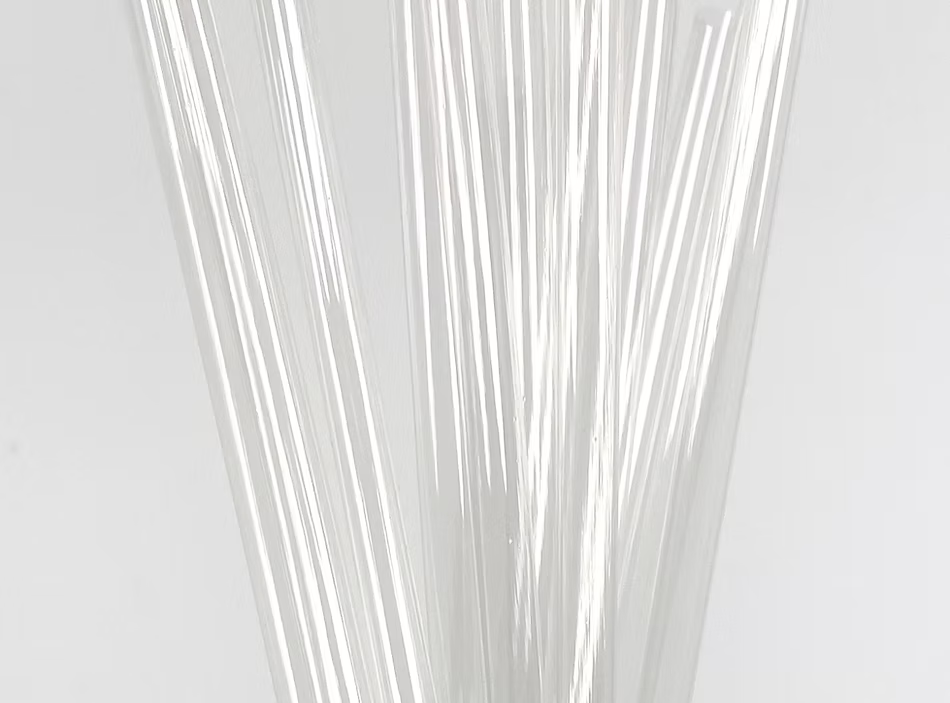
CELLULOSE ACETATE
n 1865, French chemist M. Paul Schützenberger produced the first organic ester of cellulose (cellulose triacetate) by heating cotton and acetic anhydride to about 180 °C in a sealed tube until the cotton dissolved. Uniquely, it had a degree of substitution (DS) of about three but was soluble only in expensive solvents. FAST FORWARD 150 years, and Cellulose Acetate has an opportunity to create drinking straws suitable for cold drinks. Made primarily with 40-50% wood pulp our straws meet ISCC standards for sustainability and sustainability credits.
Know some key concepts for your clearest
understanding
What are our biodegradable straws?
These are straws manufactured with an ecological guarantee where we use biotechnologies that allow the straws to be biodegradable in aerobic and anaerobic environments and at the same time be 100% recyclable.
What are our natural agave fiber or cornstarch straws?
These are straws with an ecological guarantee made from organic materials such as natural fibers or starches and that when manufactured with biotechnology reduce the use of plastic materials and allow proper biodegradation.
Which technology do we use?
We use as many organic additives, bio-based polymers and resins manufactured from natural elements which maintain all the physical properties of the straw from the beginning since with these materials an accelerated biodegradation is initiated when in contact with microorganisms both those found in aerobic and anaerobic environments and the marine environment. Our straws do not biodegrade while on the shelf or during storage.
What is compostable?
Compostable means that the plastic can be degraded by controlled conditions of temperature, humidity and by the action of (biologically) organisms producing water, carbon dioxide, inorganic compounds and biomass in a controlled period of time; in other words, it can act as compost. Therefore, all materials are biodegradable, but not all biodegradable ones are compostable.
What is Biodegradable?
Biodegradable plastics are designed to degrade by the action of microorganisms such as bacteria, fungi, which use them as a source of carbon. Similarly with physical agents such as the sun or water in environmental conditions that occur in nature and transform these substances into nutrients, carbon dioxide, water and biomass.
What is Oxo-Biodegradable?
Recycling of plastics
It can be said that all plastics are recyclable, the first step being their separation by type of polymer. We can mention seven different types of plastics: PET, HDPE, PVC, LDPE, PP, PS and a seventh category called “others” which are already classified by means of numbers inscribed in a recycling indicator triangle.
Applicable Standards for Composting
The applicable European standard is UNE 13432 “Packaging”. Requirements for containers and packaging that can be recovered through composting and biodegradation. Test program and evaluation criteria for the final acceptance of the container or packaging” specifies the requirements and procedures to determine the biodegradability and compostability of the plastics. Within this standard, it is also necessary to consider the environment in which the material may end up after use, and it is possible to certify biodegradability in the marine environment, fresh water and soil.
Characteristics of Biodegradable and Compostable straws
They degrade in aerobic, anaerobic and marine environments. The most common are landfills. – Anaerobic: A process of biodegradation in the absence of oxygen. – Aerobic: Biodegradation process in the presence of oxygen. – Marine environments: In the presence of both Aerobic and Anaerobic and with the presence of water and UV rays.
2) ASTM (American Society for Testing and Materials) standards are international standards for establishing biodegradation under Aerobic, Anaerobic and Marine conditions.
3) POPOMEX Straws show in laboratory tests an effective biodegradation according to the standards established by ASTM and UNE 13432.
4) POPOMEX Straws have all the corresponding certificates to guarantee the quality, safety and above all the peace of mind of our customers.
5) The physical characteristics of our straws are the same as those of conventional plastic straws.
6) POPOMEX straws are stored in the same way as plastic straws.
7) The materials used are approved by the FDA (Food and Drug Administration) for products in contact with food and human beings.
8) The colors required by our customers can be manufactured.
In POPOMEX and BIOMARINE, you will find the optimal option in the type of straw you need, besides having the highest quality and certification that our straws fulfill, all the certifications and guarantees that they are biodegradable and compostable.